PSU Redundancy: N+1 vs 2N
PSU redundancy planning comes down to how many nines of availability you buy and what N+1 vs 2N actually costs per rack.
Redundancy definitions and the cost of nines
Redundancy math starts with the load: N has exactly enough PSUs for full IT load, N+1 adds one spare so a single PSU failure does not take the rack down, and 2N doubles the entire power path so one side can be isolated while the other carries 100%. The difference is priced in nines: N lands below 99.9%, N+1 around 99.99%, and 2N closer to 99.999% with upstream UPS.
Modern CRPS modules make this concrete. An HPE 3200W M-CRPS Titanium PSU runs at 96% efficiency at half load, so 2N with two 3200 W units sharing a modest load consumes less overhead than one oversized PSU at 30% load. Verify the efficiency curve before choosing: fault tolerance comes first, but every percentage point shows up in PUE.
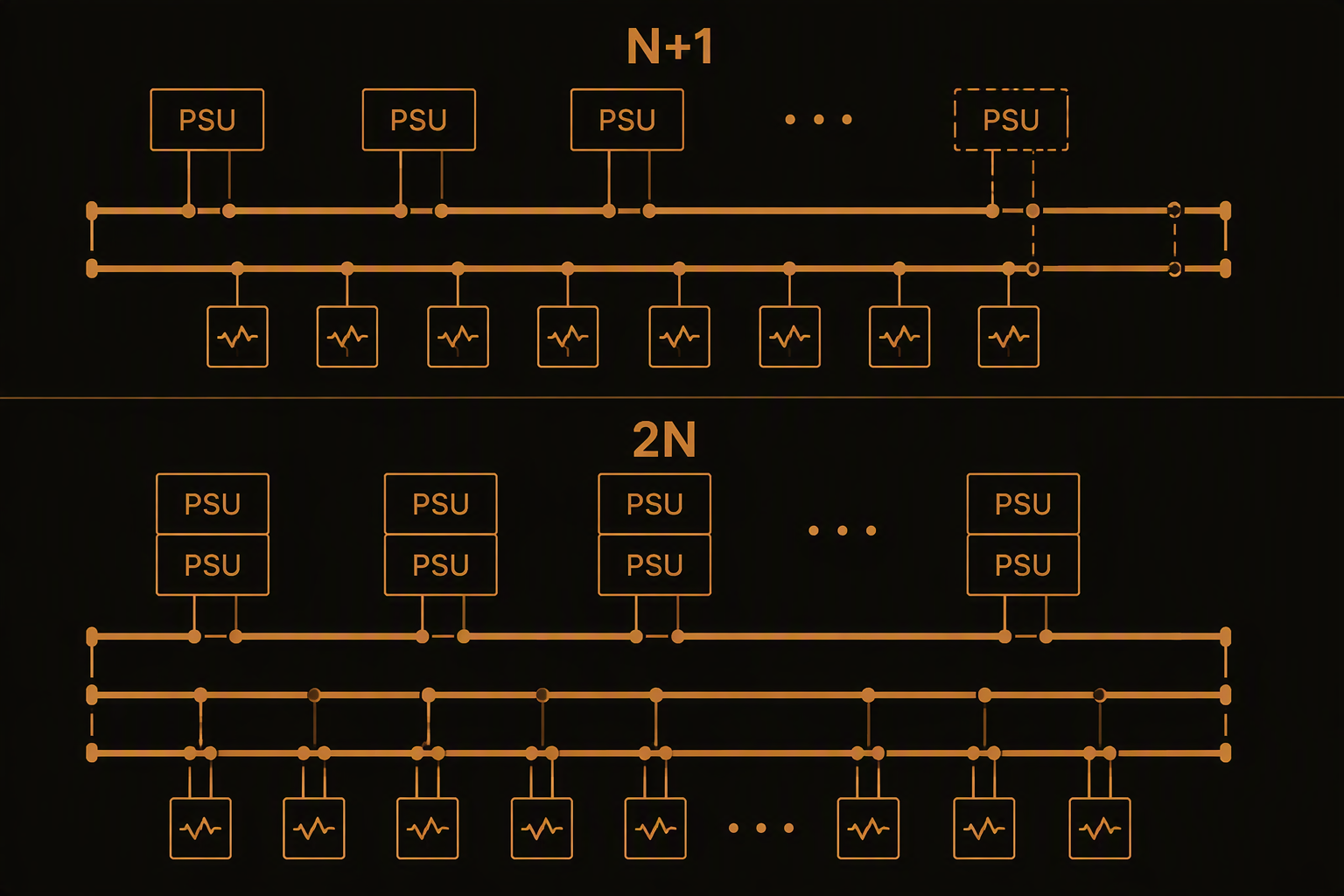
Topology map: N+1 vs 2N
The schematic on the left shows N+1 on a shared PSU bus; the right shows 2N with independent feeds and PSU sets. Once rack power crosses 120 kW, liquid cooling becomes mandatory and the redundancy topology has to be decided before the busway drop is sized.
- N+1 uses a shared bus with one hot spare PSU
- 2N uses two independent feeds and two independent PSU sets
- 2(N+1) adds a spare PSU to each side of a 2N design
- For 48V ORv3 racks, the BBU shelf replaces per-server battery backup
- Busway drops must be sized for the full 2N load before PSU count is set
- IEC C13/C19 outlet counts limit how many high-wattage PSUs one rack PDU can feed
N+1 vs 2N vs 2(N+1) at a glance
| Parameter | N+1 | 2N / 2(N+1) |
|---|---|---|
| Definition | N PSUs plus one shared spare | Two independent power paths with N PSUs each; 2(N+1) adds one spare per side |
| Availability contribution | One PSU failure tolerated | One feed, UPS, breaker, or PSU failure tolerated |
| PSU count for 6.4 kW rack using 3200 W units | 3 (N=2 + 1 spare) | 4 for 2N; 6 for 2(N+1) |
| Efficiency at half load | 96% on Titanium M-CRPS | 96% on Titanium M-CRPS, with more modules sharing load |
| Maintenance scenario | Hot-swap one PSU without runtime impact | Isolate a full side for busway or breaker work |
| Typical use case | Standard CPU racks, modest GPU trays | AI racks crossing 120 kW or facilities with weak utility |
| 48V ORv3 impact | BBU shelf can cover short events | Dual BBU shelves or 2(N+1) for continuous availability |
How BBU modules change the equation
The OCP Open Rack V3 BBU Shelf specification Rev 1.1 defines a 48 V battery shelf between the busway and the server trays. That shifts ride-through power from a central UPS to the rack, which changes the redundancy question: instead of doubling every PSU to protect against an upstream failure, you can keep N+1 PSUs for conversion and let the BBU shelf cover the 30-60 seconds needed to transfer or shed load.
For 48V ORv3 GPU trays, the architecture replaces the older 12V distribution, and the BBU shelf handles inrush peaks when trays power up. In AI racks crossing 120 kW, this is why BBU shelves and 48V busways are in high demand — Guangdong computing-hardware factories are booked into next year on exactly these components.
Sourcing PSUs for N+1 or 2N?
Send us your rack power profile and target availability — we’ll match CRPS and BBU SKUs from audited Shenzhen factories.