Air to Liquid: The Transition Guide
This liquid cooling transition guide explains why 120 kW per AI rack forces the move, plus retrofit vs greenfield and 48V power changes.
The 120 kW threshold
Wedbush projections put AI racks beyond 120 kW per cabinet in 2026, and at that density liquid cooling becomes mandatory. The thermal arithmetic is unforgiving: a single 120 kW rack rejects roughly 410,000 BTU/h, far beyond what conventional air-side CRACs can handle without consuming enormous floor area and fan power. For procurement managers, the trigger is physics, not vendor preference—once GPU trays exceed air cooling's practical envelope, you cannot simply add more airflow; you must change the heat-rejection medium.
This transition guide addresses the shift from air to liquid at the rack, the retrofit-versus-greenfield decision, and the power distribution changes that follow. The critical change: 48V ORv3 architecture replaces legacy 12V for GPU trays, so cooling and power specifications must be finalized together. Waiting until after the busway is sized leads to expensive rework.
Read the rack cross-sections
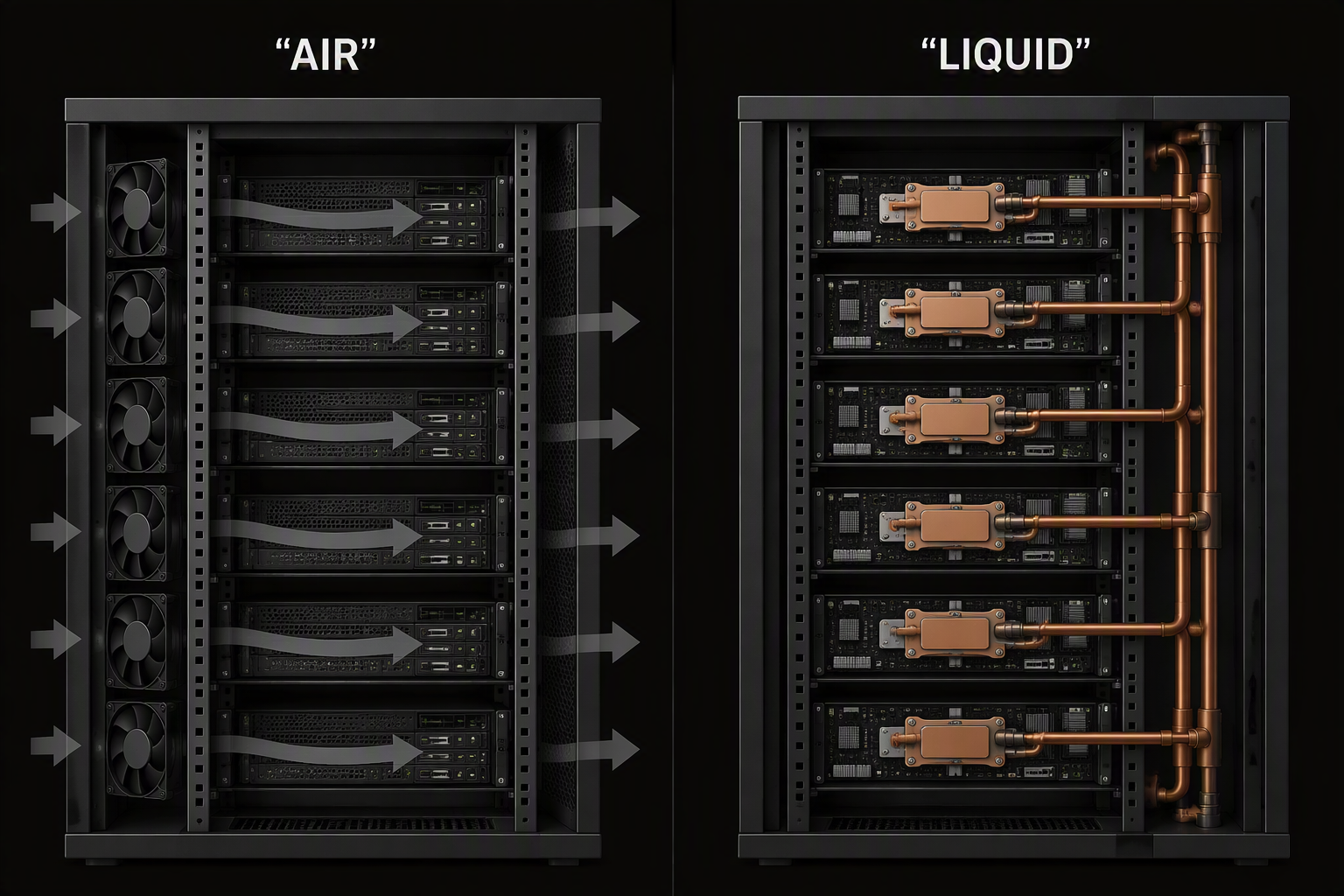
At 120 kW per rack, a rear-door heat exchanger alone is insufficient; you need direct-to-chip cold plates or immersion. The cross-sections show how air-cooled racks push front-to-back airflow through high-CFM fans, while liquid loops place coolant at the heat source with higher supply temperatures, preserving chiller-free operation for more hours each year.
CDU capacities now span 300 kW to 1.2 MW per unit, which maps cleanly onto a single row or a pair of 120 kW racks. Specifying the CDU, manifold, and coolant distribution unit together with the 48V power shelf avoids the retrofit trap of adding liquid loops after the busway is already sized for air-cooled loads. In practice, every high-density row needs its own coolant loop and rack-level instrumentation to balance flow and temperature.
- Air-cooled rack: 10–30 kW typical envelope before hot spots form
- Liquid-cooled rack: 120–500+ kW with cold plates and 48V power
- CDU: 300 kW entry-level, 1.2 MW for high-density AI rows
- Interface: blind-mate connectors on manifolds, serviceable from cold aisle
Retrofit vs greenfield
| Criteria | Retrofit | Greenfield |
|---|---|---|
| Cooling integration | Add CDUs and piping into existing whitespace; ceiling and floor routing constraints dominate design. | Design CDU (300 kW–1.2 MW) and manifold layout before slab pour; no routing conflicts. |
| Power architecture | Costly 12V to 48V ORv3 conversion; new busway drops required for GPU trays. | Run 48V ORv3 natively to GPU trays; eliminate conversion losses and shelf clutter. |
| Transformer lead time | Upgrades depend on existing capacity; if a new transformer is needed, 160-week lead times apply. | Procure transformers immediately; global lead times currently reach 160 weeks (Edgen). |
| Schedule risk | Half of planned US data centers were delayed or canceled in 2026; retrofits add permitting risk. | Better control, but grid interconnection and equipment availability remain critical. |
| Busway capacity | Existing busway capacity may be insufficient; high-density rows demand 6300 A. | Specify 6300 A busway, IEC 61439-6 type tested, from day one. |
| US tariff exposure | Chinese dry-type transformers face 46.6% tariffs, with some lines reaching +125%. | Same tariff exposure; favor audited manufacturers and early logistics. |
| Factory availability | Retrofit kits still require Guangdong factories that are booked into next year. | New equipment for greenfield comes from the same booked lines; lock capacity early. |
Power distribution changes that follow
- 48V ORv3 replaces 12V for GPU trays, reducing distribution loss at 120 kW rack current.
- OCP Open Rack V3 BBU Shelf Rev 1.1 provides 48V ride-through for AI server loads.
- HPE 3200W M-CRPS Titanium power supplies hit 96% efficiency at half load, cutting waste heat.
- UL 62368-1 covers PDUs/PSUs; UL 1973 and UL 9540A cover BBU battery safety and installation.
Start the specification now
Guangdong computing-hardware factories are booked into next year; lock your PDU, busway, and 48V BBU capacity before lead times stretch further.