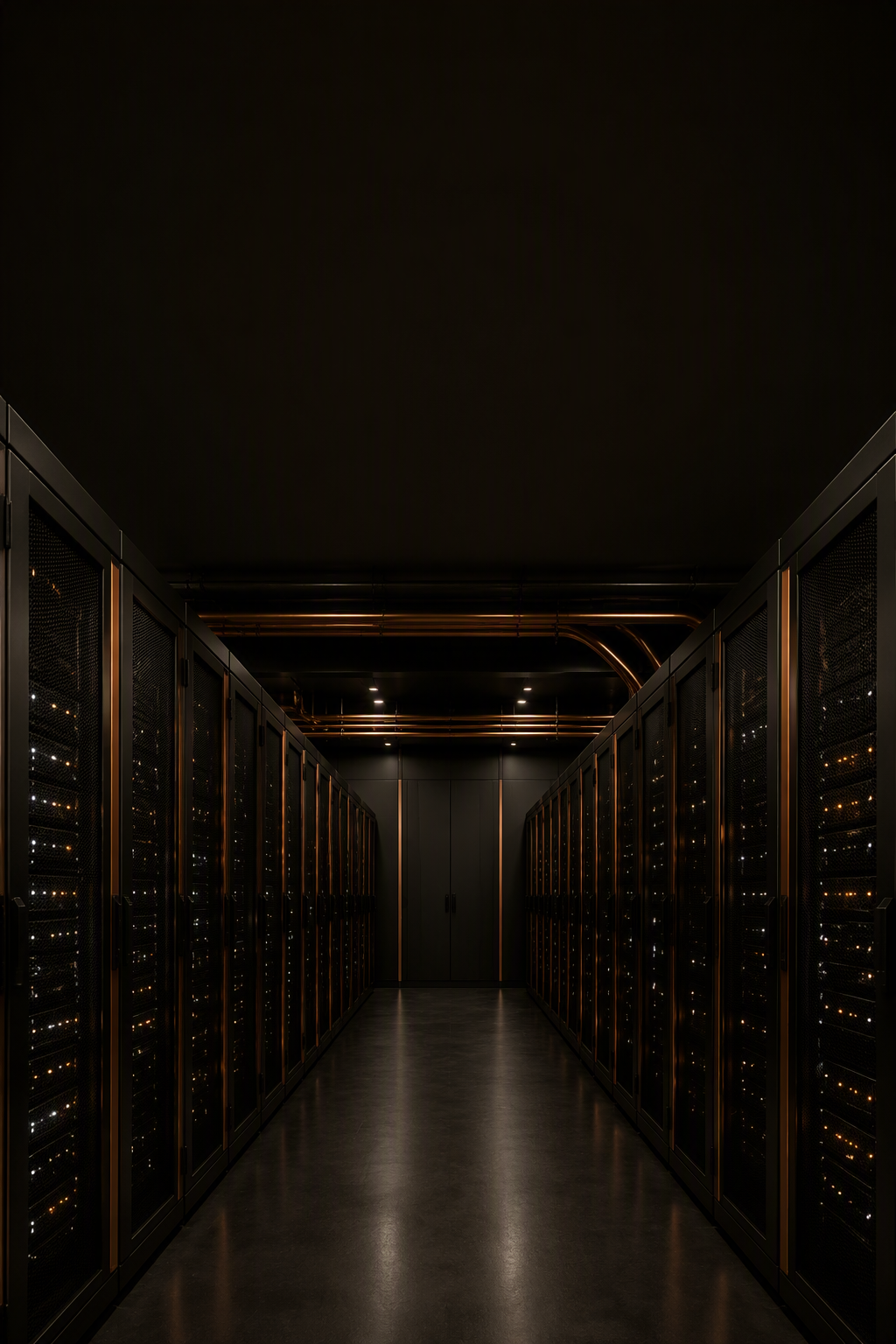
Rack Busbar Power
Rack busbar power feeds 120 kW cabinets without cable trays you cannot rewire, using overhead busway tap-offs or in-rack busbar.
In-Rack vs Overhead Busbar
AI racks crossing 120 kW per cabinet force a hard break from 3-phase whips under a raised floor. At this density, cable trays become a rework liability: adding a 22 kW PDU feed means pulling new conductors, derating for fill, and scheduling downtime. Overhead busway with plug-in tap-offs and in-rack busbar are the two acceptable replacements because both move the feeder closer to the rack and leave the hot aisle unchanged.
Overhead busway serves an entire row from a single 6300 A run, while in-rack busbar distributes 48V ORv3 power inside the cabinet to GPU trays. The decision is largely mechanical: overhead suits brownfield halls with high ceilings, in-rack suits OEM-style deployments where the busbar ships pre-integrated and phase balancing is fixed at the factory. Procurement should ask for IEC 61439-6 type-tested assemblies either way.
Overhead Busway vs In-Rack Busbar
| Parameter | Overhead Busway | In-Rack Busbar |
|---|---|---|
| Typical rating | Up to 6300 A with plug-in tap-offs, IEC 61439-6 type tested | 48V ORv3 rack-level distribution, sized per GPU tray |
| Reconfiguration | Add tap-off boxes under load; no new feeder pull | Swap rack internal modules; factory or bench work |
| Installation | Overhead runway above rack row; needs ceiling structure | Pre-installed in rack or retrofit into cabinet rear |
| Cable reduction | Eliminates most 3-phase whips to rack PDU | Eliminates cable harness inside the rack |
| Hot-aisle impact | Low; tap-offs accessed from cold aisle or overhead | Minimal; busbar occupies 1U-2U rear space |
| Phase balancing | Field adjustable at tap-off PDU | Set at integration; harder to rebalance live |
| Cooling compatibility | No conflict with liquid cooling CDUs mounted in-row | Leaves rear 1U-2U space; no impact on CDU units from 300 kW to 1.2 MW |
| Best fit | Brownfield rows with multiple PDU changes | High-density AI racks with fixed 120 kW cabinet loads |
GPU Rack Feeding Checklist
- Confirm 48V ORv3 power architecture before specifying GPU tray busbar positions and connector types.
- Size overhead busway at up to 6300 A so row capacity covers 120 kW per cabinet.
- Specify IEC 61439-6 type-tested tap-off boxes instead of site-built cable joints, especially above 630 A.
- Use C19 or C21 outlets for 16 A hot-condition feeds to rack PDUs and liquid cooling CDUs.
Busbar + PDU Pairing
A busbar run is only as usable as the PDU hung from it. For high-density racks, Server Technology PRO4X class switched PDUs deliver 11-22 kW and 48 outlets as 24xC13 plus 24xC19 HDOT, so a single tap-off can feed both IT and network gear without secondary strips. Switched outlet control lets operators shed non-critical load when a row approaches its 6300 A busbar limit.
Billing-grade metering at +/-1% accuracy is the procurement baseline for multi-tenant data halls where busbar capacity is chargebacked to customers. If the rack PDU does not report per-outlet energy, the finance team cannot reconcile the 120 kW cabinet load by tenant, and the busbar project becomes an operations cost rather than a recoverable service. Spec the bill-back interface before ordering to avoid stranded metering data.
Source Rack Busbar Power
Request a three-vendor comparison for type-tested overhead busway and 11-22 kW switched PDU packages with 15-30 day Shenzhen lead times and IEC 61439-6 test reports.