Copper vs Aluminum Busbar
Choosing copper vs aluminum busbar comes down to ampacity per dollar, corrosion behavior, and total landed cost — the numbers matter.
Copper vs aluminum busbar at a glance
| Parameter | Copper busbar | Aluminum busbar |
|---|---|---|
| Ampacity (IACS) | 100% IACS baseline | 61% IACS; needs ~160% cross-section for the same current |
| Weight for equal ampacity | 100% baseline | ~50% of copper weight, including the larger bar |
| Material cost | LME Cu premium; typically 3-4x aluminum per ton | LME Al; ~30-50% lower busway material cost |
| Jointing | Bolted Cu-Cu joints stay stable with optional plating | Needs Belleville washers, Cu-Al bimetallic transition, and torque control |
| Oxidation | Oxide layer remains conductive | Oxide film is insulating; needs antioxidant compound or plating |
| Thermal expansion | 16.5 ppm/°C | 23 ppm/°C — 40% higher, so expansion joints are required on long runs |
| Recycling value | ~90-95% of LME copper value retained | ~30% of copper scrap value; tracks LME aluminum |
| Data center preference | Dominant for 6300 A type-tested busway and AI rack feeds | Used in cost-sensitive long horizontal feeders where ampacity per dollar wins |
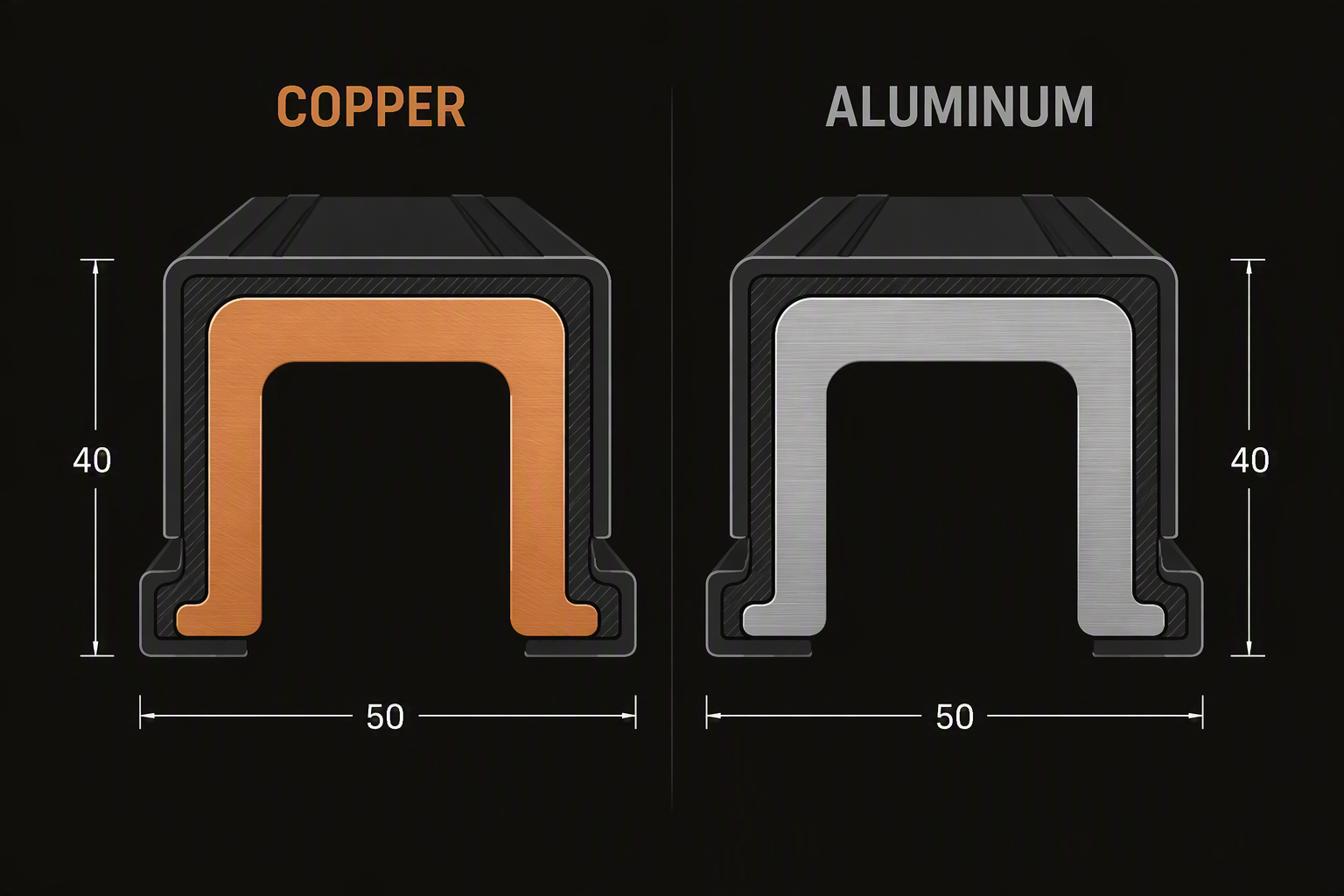
Reading the cross-section
A 100×10 mm copper and aluminum bar share the same footprint, but the aluminum bar runs about 1.6 times more resistance at the same temperature. To reach a 6300 A rating, designers either increase aluminum cross-section, parallel bars, or shorten feeder segments—and each choice changes mechanical support spacing and enclosure size.
- Aluminum's 23 ppm/°C expansion vs copper's 16.5 ppm/°C means long busways need expansion joints at calculated intervals
- Plated copper joints hold millivolt drop stable across thermal cycles; aluminum joints need documented re-torque schedules in high-load AI halls
LME pricing and tariff reality
Jintian Copper's H1 profit climbed 204%, lifted by copper busbar demand for AI servers — proof that copper consumption now tracks compute density as much as construction starts. For a 2 MW data hall, the material-cost gap between a copper and aluminum busway is real, but it shrinks once voltage-drop limits, joint maintenance, and support spacing enter the calculation.
Tariffs complicate the comparison. US duties on Chinese dry-type transformers hit 46.6% on some lines, with other classifications at +125%; transformer lead times are already stretched to 160 weeks globally. That means a busbar change order late in a project is not a simple swap — the surrounding power chain is too constrained.
Frequently asked
Spec the metal, then the system
Send us your SLD, ampacity, and voltage-drop limits — we'll quote the same busway route in copper and aluminum with landed-cost math.