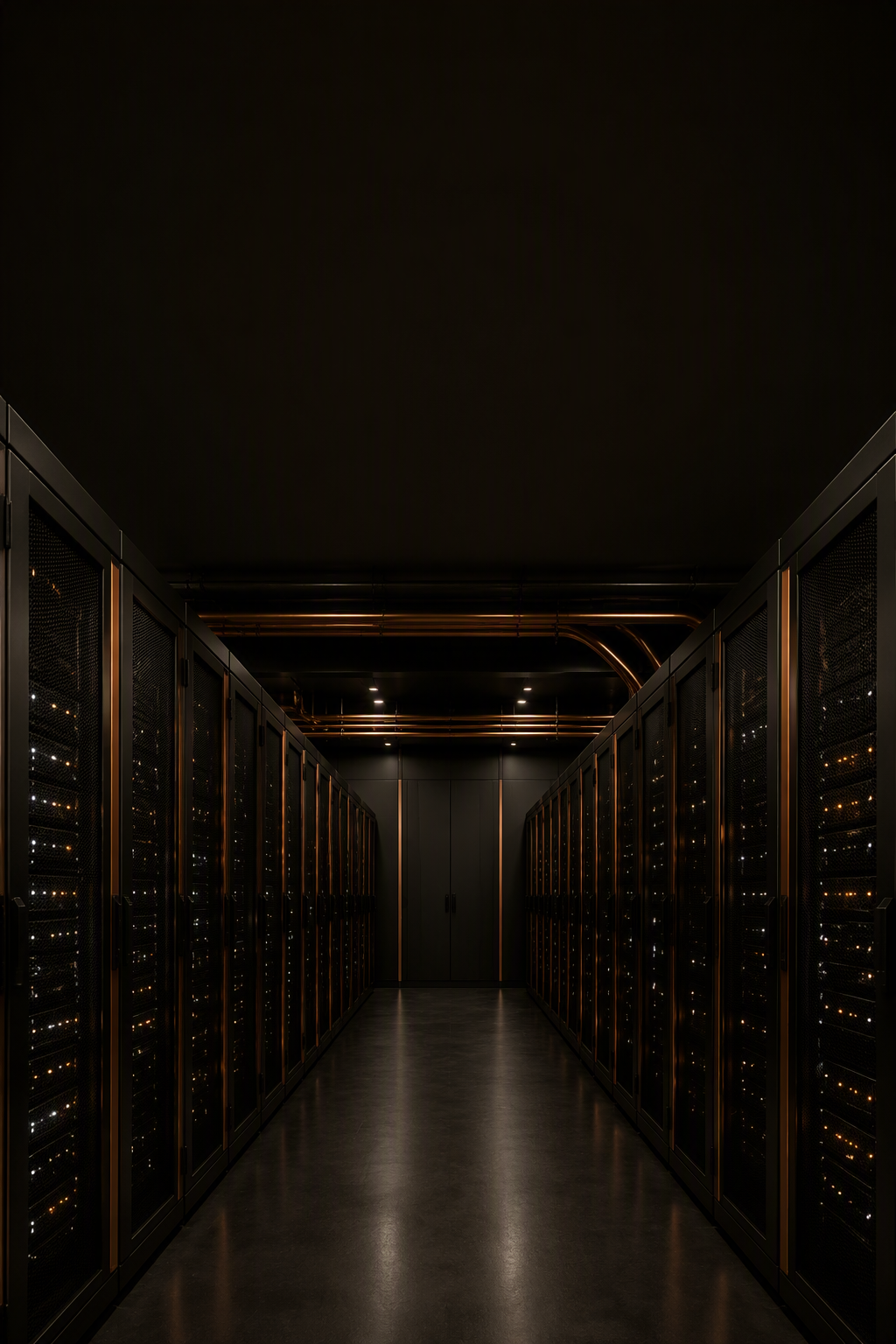
Busway Trunking Systems
Busway trunking systems: overhead copper that makes every rack position a potential tap point in high-density data halls.
Trunking Anatomy for Data Halls
Busway trunking replaces long parallel cable runs with a compact insulated copper path suspended overhead in the data hall. The trunking carries continuous copper conductors and presents tap-off windows along the run, so each rack position becomes a plug-in point for a fused tap-off box feeding a rack PDU. Reference systems such as Legrand XCP and Schneider I-Line support rated current up to 6300 A, enough for high-density AI rows where per-cabinet loads cross 120 kW and liquid cooling becomes mandatory.
Because these systems are type tested to IEC 61439-6, the busbar assembly, housing, joints, and tap-off units are validated as a complete low-voltage switchgear and controlgear assembly, not as field-built cable ladders. Buyers should specify busway as a system, including end feed, center feed, tap-off boxes, and cast resin or insulated sections for the mechanical environment.
Trunking Specification Points
| Parameter | Value |
|---|---|
| Rated current | Up to 6300 A in compact insulated trunking |
| Conductor | Copper busbar, solid or laminated bar |
| Type-test standard | IEC 61439-6 assembly verification for busbar and tap-off units |
| North American standard | UL 857 for busway systems |
| Reference platforms | Legrand XCP and Schneider I-Line |
| Tap-off spacing | 500-1000 mm on overhead trunking runs |
| Typical mounting | Overhead, zone feed or center feed |
| Feeder consolidation | One copper path replaces parallel cable tray feeds |
| Mating equipment | Fused tap-off boxes feeding rack PDUs |
| Copper allocation signal | Jintian Copper H1 profit +204% on AI server busbar |
| Regional factory slot | Guangdong computing-hardware factories booked into next year |
| Deployment context | AI racks crossing 120 kW per cabinet where liquid cooling is mandatory |
Installation Advantages vs Cable
- One 6300 A copper trunk run consolidates multiple parallel cable trays into a single overhead path.
- Tap-off positions at 500-1000 mm spacing allow rack moves without re-pulling feeder cables.
- IEC 61439-6 type testing removes one-off field joint and lug work on every feed.
- Plug-in tap-off boxes turn stranded capacity into live rack positions faster than cable pulls, with fewer support trades.
Lead Time, Copper Allocation, and Factory Slots
Copper busbar demand is not abstract. Jintian Copper H1 profit +204% driven by copper busbar for AI servers shows where allocation is moving, and copper busbar is now a constrained input for power distribution rather than a commodity purchased at order date. For procurement, link PO pricing to copper index and reserve the factory slot early.
Guangdong computing-hardware factories are booked into next year, so busway trunking slots are tied to the same regional constraint as rack PDUs and BBU shelves. That means buyers need approved drawings, copper allocation, and tap-off schedules before the factory window opens, not after. A data hall design freeze is not enough; PO placement must align with factory slot reservations and verified IEC 61439-6 test reports. Copper allocation must be named in the PO, not left to production planning.
Lock Busway Allocation Now
Send drawings, tap-off schedules, and copper allocation requirements to audited Shenzhen busway suppliers now. Compare IEC 61439-6 test reports, factory slot dates, and landed cost before the Guangdong build window closes.